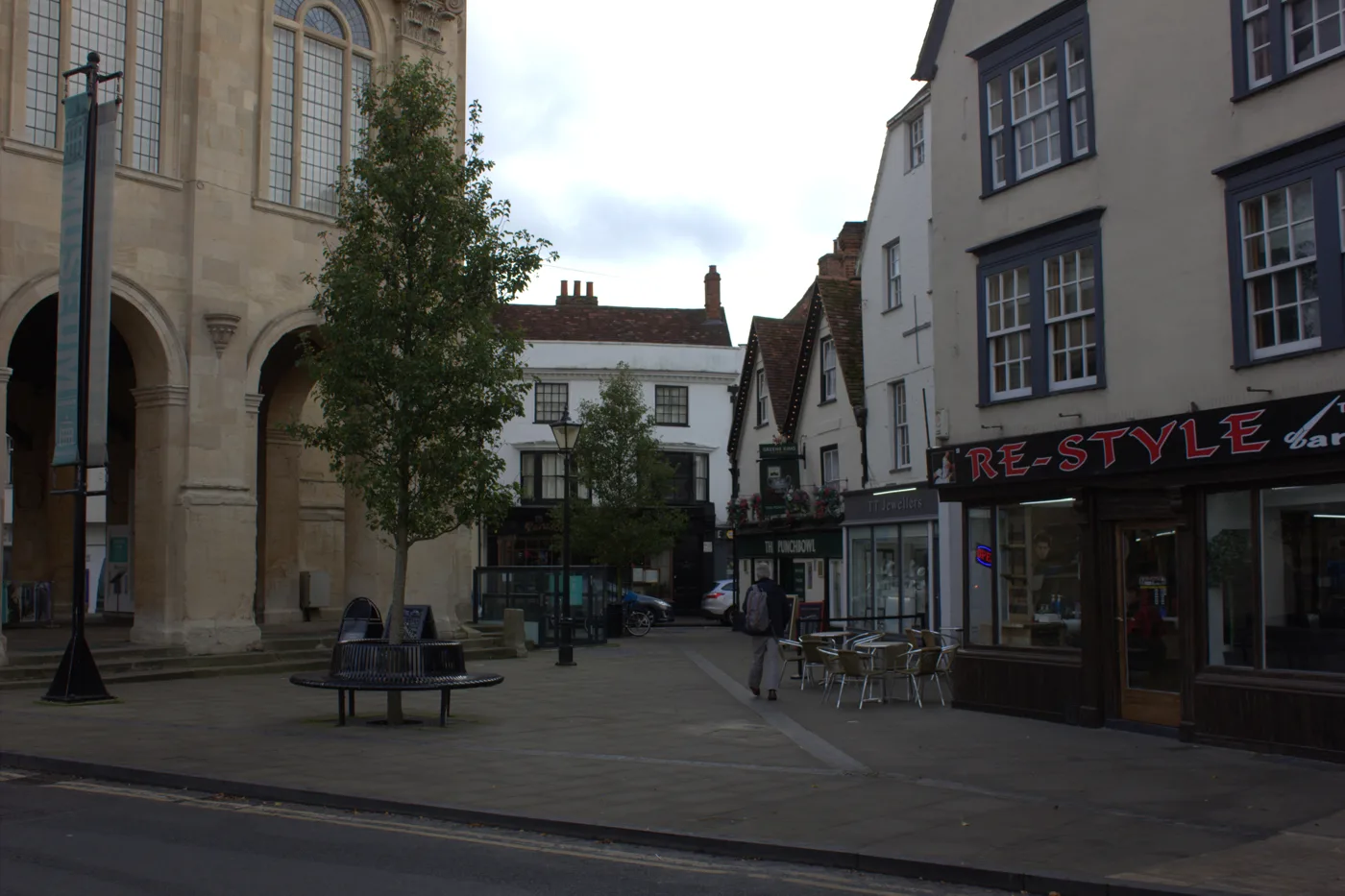

Seven Abingdon town centre premises have been empty for over a year, a council report says. Cabinet is advised not to use rental auction powers yet.
Seven premises in Abingdon town centre have stood empty for more than a year. They are on Bath Street, Bury Street and High Street. The figure comes from a report to the Vale of White Horse District Council’s Cabinet, which meets on Friday 27 November.
The report looks at High Street Rental Auctions, a power that lets a council make a landlord rent out a long-empty shop or office. Officers recommend that the Vale does not start using it for now.
Overview
- Abingdon town centre has seven premises empty for more than 12 months, Wantage four and Faringdon three, from the council’s business rates records for September 2026.
- The council could force auctions of the tenancies of long-empty units, but officers say it lacks the staff and money to run them.
- Cabinet is asked to back “Option B”: keep the power for later, do limited groundwork, and cost cheaper alternatives instead.
- The meeting is at 10.30am on Friday 27 November. The agenda has a slot for members of the public who have registered to speak.
Where the long-empty premises are
Officers checked the council’s Business Rates Register as it stood in September 2026. They counted premises in the main retail centres that had been empty for more than 12 months.
| Town centre | Premises empty over 12 months | Share of premises | Streets named |
|---|---|---|---|
| Abingdon | 7 | 3.54% | Bath Street, Bury Street, High Street |
| Faringdon | 3 | 5.08% | Cornmarket, Market Place |
| Wantage | 4 | 2.41% | Market Place, Wallingford Street |
Wantage is about eight miles south west of Abingdon, and Faringdon about 13 miles west.
The report warns that these are not the towns’ overall vacancy rates. Those will be higher, because they also include units that have been empty for less than a year. Officers call that “frictional” vacancy: shops between tenants, being refitted or under negotiation. The units in the table are what the report calls “structural” vacancy.
For comparison, the report says the UK average vacancy rate has moved between 12 and 17 per cent in recent years. A rate below 10 per cent is generally seen as healthy.
The council’s property team told officers the Vale “remains one of the stronger market-town retail locations in Oxfordshire”. It credits an affluent population, housing growth and the pull of Oxford and Science Vale.
How a rental auction would work
The powers come from the Levelling Up and Regeneration Act 2023. A council can use them only on premises that meet strict tests:
- the unit must have been empty for the whole of the past year, or for at least 366 days in the past two years
- it must be on a street the council has formally designated as a high street, after at least 28 days of public consultation
- the council must judge that letting it would benefit the local economy, community or environment
The council would then serve notice on the landlord. That starts a 10 to 12 week period in which the landlord can avoid an auction, for example by signing a new tenant. If no tenant is found, the council auctions a lease over a further 12 weeks.
The landlord has two working days to pick a winning bid. If they do not, the council can choose the highest bid. The landlord must bring the premises up to a minimum standard, including working water, electrics, toilets and an intact shop front.
A landlord who fails to answer the council’s requests for information without a reasonable excuse commits a criminal offence. The fine is up to level 4 on the standard scale, which the report puts at £2,500.
Why officers say not yet
The report says running auctions would draw on legal, property and planning staff who are “already limited or under severe pressure”. Officers say the work “would not be deliverable under current resources”.
The money is thin too:
- the government pays £5,223 per auction, in arrears, which the report says will not cover the council’s full cost
- there is no government money for setting the process up
- a £10 million national fund for rental auction work opens to bids from 23 November 2026, assessed on a rolling basis
The Vale is not among the 60 councils chosen for the government’s separate £125 million Derelict Buildings Fund, the report notes.
Officers also point to the experience of pilot councils. Government figures from June 2026 showed the pilots had helped bring more than 60 units back into use, often without holding an auction. The threat of one was often enough to get landlords moving.
What the council would do instead
Under Option B, officers would gather updated property information and look at where an auction might be justified later. They would also cost three alternatives for a future budget:
- Town centre investment partnerships: working groups of the district council, town councils and local businesses to find new occupiers for problem units
- High street activation funds: small grants for decoration, lighting, signage and shop front work to get empty units re-let
- A meanwhile spaces programme: short lets of empty units for pop-up shops, seasonal shops, art installations and creative spaces
Every option would have to go through the council’s normal budget process. Cabinet could instead choose Option A, to start setting up auctions now, or Option C, to do nothing.
What it means for you
If you want to have your say before Cabinet decides, the meeting has a public participation item. Contact democratic services on 01235 422422 or at democratic.services@southandvale.gov.uk to register to speak. The agenda and reports are online.
If the council does move to auctions in future, the first public step would be a proposal to designate streets as high streets. That would be published for at least 28 days of comment.
Business owners looking for a town centre unit should note the “meanwhile” idea. If it goes ahead, it would open short, cheaper lets in empty premises across Abingdon, Wantage and Faringdon. Nothing has been budgeted yet.
Have your say